
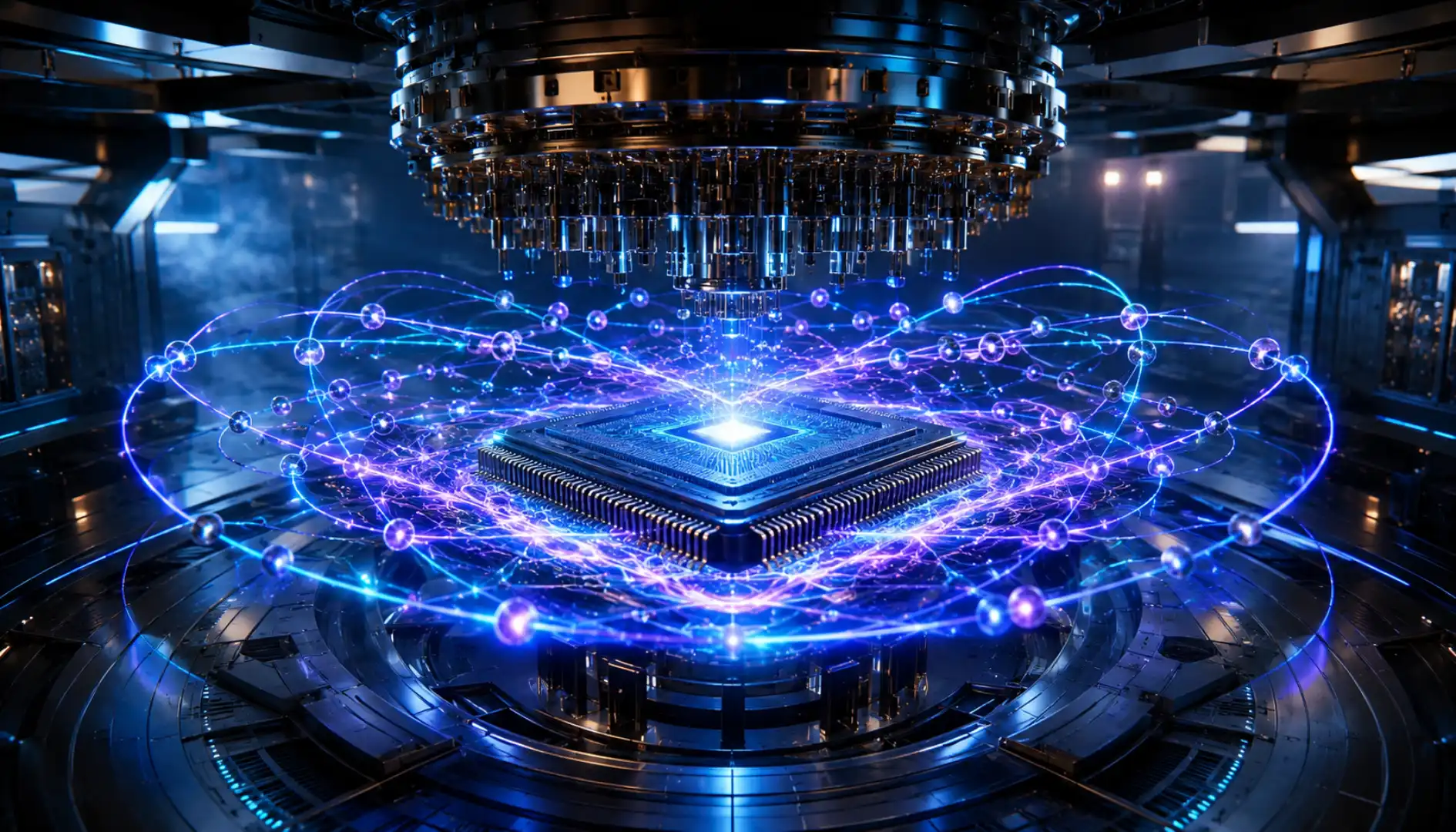
Quantum computing is one of the most revolutionary technologies of the 21st century. While traditional computers have powered the digital world for decades, quantum computers introduce an entirely new way of processing information using the laws of quantum mechanics.
But how does a quantum computer actually work?
In this guide, we’ll break down the process step by step using simple explanations, real-world examples, and visual concepts that beginners can easily understand.
Quick Answer
A quantum computer works by storing information in qubits, which can exist in multiple states simultaneously through a property called superposition. These qubits interact through entanglement and are manipulated using quantum gates. After performing calculations, the quantum state is measured to produce a final result.
TL;DR
- Traditional computers use bits (0 or 1).
- Quantum computers use qubits.
- Qubits can be 0, 1, or both at the same time.
- Quantum gates manipulate qubits.
- Entanglement connects qubits together.
- Measurement converts quantum information into classical results.
- Quantum computers excel at specific complex problems.
Why Quantum Computers Are Different
Traditional computers process information using billions of transistors.
Every piece of information is represented as either:
0
1
These are called bits.
Quantum computers use a different unit of information called a qubit.
Unlike classical bits, qubits can represent multiple possibilities simultaneously, allowing quantum systems to explore many solutions at once.
Why Understanding Quantum Computers Matters
Quantum computing is one of the most important emerging technologies of the 21st century. Major companies such as IBM, Google, Microsoft, Amazon, and Intel are investing billions of dollars into quantum research.
Quantum computers have the potential to revolutionize:
- Artificial Intelligence
- Drug Discovery
- Financial Modeling
- Cybersecurity
- Climate Science
- Logistics Optimization
To understand this technology, let’s break down exactly how a quantum computer works.
Step 1: Information Is Stored in Qubits
The foundation of every quantum computer is the qubit.
A classical computer stores information using bits and value 0 or 1.
A quantum computer stores information using qubits and possible state 0, 1, or both simultaneously.
A qubit can be created using:
- Superconducting circuits
- Trapped ions
- Photons
- Quantum dots
- Neutral atoms
Because qubits follow quantum mechanics, they behave very differently from classical bits.
Step 2: Qubits Enter Superposition
One of the most powerful concepts in quantum computing is superposition.
A classical bit is either:
0
OR 1
A qubit can be:
0
1
Both 0 and 1 simultaneously
Think of a coin.
A coin lying flat is either heads or tails.
A spinning coin represents both possibilities at the same time.
This is similar to how superposition works.
Why Superposition Matters
Instead of checking one possibility at a time, quantum computers can explore many possibilities simultaneously.
This gives quantum systems enormous computational power for certain types of problems.
Step 3: Qubits Become Entangled
The next step involves entanglement.
Entanglement occurs when two or more qubits become connected in a way that their states depend on each other.
For example:
- Qubit A changes
- Qubit B instantly reflects that relationship
Even if they are separated by large distances.
Spooky action at a distance.
Entanglement allows quantum computers to coordinate information across many qubits simultaneously.
This is one of the reasons quantum systems can outperform classical computers for specialized tasks.
Step 4: Quantum Gates Perform Operations
Classical computers use logic gates such as:
- AND
- OR
- NOT
- XOR
Quantum computers use quantum gates.
Quantum gates manipulate qubits and change their quantum states.
Common quantum gates include:
| Quantum Gate | Purpose |
|---|---|
| Hadamard Gate | Creates superposition |
| Pauli-X Gate | Quantum version of NOT |
| CNOT Gate | Creates entanglement |
| Phase Gate | Changes phase relationships |
A quantum circuit is similar to a program running on a traditional computer.
Step 5: Quantum Circuits Process Information
After applying quantum gates, the quantum computer creates a quantum circuit.
A quantum circuit:
- Receives qubits
- Applies quantum gates
- Creates superposition
- Creates entanglement
- Performs calculations
- Produces a final quantum state
Instead of calculating one path at a time, quantum circuits evaluate many possible solutions simultaneously.
This is known as quantum parallelism.
Step 6: Quantum Interference Improves Accuracy
Another critical quantum phenomenon is interference.
Quantum states can:
- Reinforce correct answers
- Cancel incorrect answers
Think of waves in water.
Some waves combine and become stronger.
Others cancel each other out.
Quantum algorithms use interference to increase the probability of finding the correct solution.
This dramatically improves computational efficiency for specific tasks.
Step 7: Measurement Produces the Result
At the end of a quantum computation, the qubits are measured.
Measurement causes the quantum state to collapse into a classical value.
Before measurement:
- Multiple possibilities exist simultaneously
After measurement:
- One final result is observed
This output is then interpreted by classical software.
Complete Quantum Computing Workflow
A quantum computer typically follows this process:
- Initialize Qubits
Qubits are prepared in a known state. - Create Superposition
Quantum gates place qubits into multiple states. - Generate Entanglement
Qubits become connected. - Apply Quantum Gates
Calculations are performed. - Use Interference
Correct solutions are amplified. - Measure Qubits
The final answer is obtained.
How Quantum Computers Differ from Classical Computers
| Feature | Classical Computer | Classical Computer |
|---|---|---|
| Information Unit | Bit | Qubit |
| State | 0 or 1 | 0 and 1 simultaneously |
| Processing | Sequential | Quantum Parallelism |
| Core Technology | Transistors | Quantum Systems |
| Strength | General Computing | Specialized Complex Problems |
Example: Finding the Correct Path
Imagine a maze with one million possible routes.
A classical computer may evaluate routes one by one.
A quantum computer can explore many routes simultaneously through superposition and interference.
This capability allows certain problems to be solved dramatically faster.
Real-World Applications of Quantum Computing
Drug Discovery
Researchers can simulate molecules more accurately than classical systems.
Benefits
- Faster medicine development
- Better treatment design
- Reduced research costs
Artificial Intelligence
Quantum machine learning may improve:
- Pattern recognition
- Optimization
- Large-scale data analysis
Cybersecurity
Quantum computers could:
- Break some current encryption systems
- Enable quantum-safe cryptography
Financial Modeling
Banks can optimize:
- Portfolios
- Risk analysis
- Market predictions
Logistics and Supply Chains
Organizations can improve:
- Delivery routes
- Scheduling
- Resource allocation
What Makes Quantum Computing Difficult?
Quantum computers face significant challenges.
- Decoherence
Quantum information is extremely fragile.
Even tiny environmental disturbances can cause errors. - Error Rates
Qubits are not perfectly stable.
Error correction remains a major research challenge. - Cooling Requirements
Many quantum computers operate near absolute zero temperatures. - High Cost
Building and maintaining quantum hardware is expensive.
Do Quantum Computers Replace Traditional Computers?
No.
Quantum computers are not designed to replace laptops, desktops, or smartphones.
Instead, they complement traditional computers.
Future systems will likely combine:
Classical processors
Quantum processors
Each handling the tasks they perform best.
Future of Quantum Computing
Experts believe quantum computing will continue advancing rapidly throughout the next decade.
Expected developments include:
- More stable qubits
- Better error correction
- Larger quantum processors
- Practical business applications
- Quantum cloud services
As the technology matures, industries ranging from healthcare to finance could experience major transformations.
Key Takeaways
- Quantum computers use qubits instead of bits.
- Superposition allows multiple states simultaneously.
- Entanglement links qubits together.
- Quantum gates perform computations.
- Interference amplifies correct answers.
- Measurement produces classical results.
- Quantum computers excel at specialized problems.
- They complement rather than replace traditional computers.
Frequently Asked Questions
A quantum computer uses qubits, superposition, and entanglement to process information in ways that traditional computers cannot.
A qubit is the basic unit of quantum information capable of existing in multiple states simultaneously.
Quantum computers can evaluate many possibilities simultaneously for specific problem types.
Superposition allows a qubit to exist in multiple states at the same time.
Entanglement is a quantum phenomenon where qubits become interconnected and share information.
Future quantum computers may break certain encryption methods, which is why post-quantum cryptography is being developed.
Yes. Companies such as IBM, Google, Microsoft, and Amazon offer cloud-based access to quantum computing platforms.
No. Quantum computers are specialized systems designed for specific computational tasks.
Final Thoughts
Quantum computing represents a fundamentally new approach to computation. By leveraging superposition, entanglement, quantum gates, and interference, quantum computers can solve certain problems far more efficiently than traditional systems.
Although the technology is still evolving, its impact on science, medicine, finance, artificial intelligence, and cybersecurity could be transformative in the years ahead.