
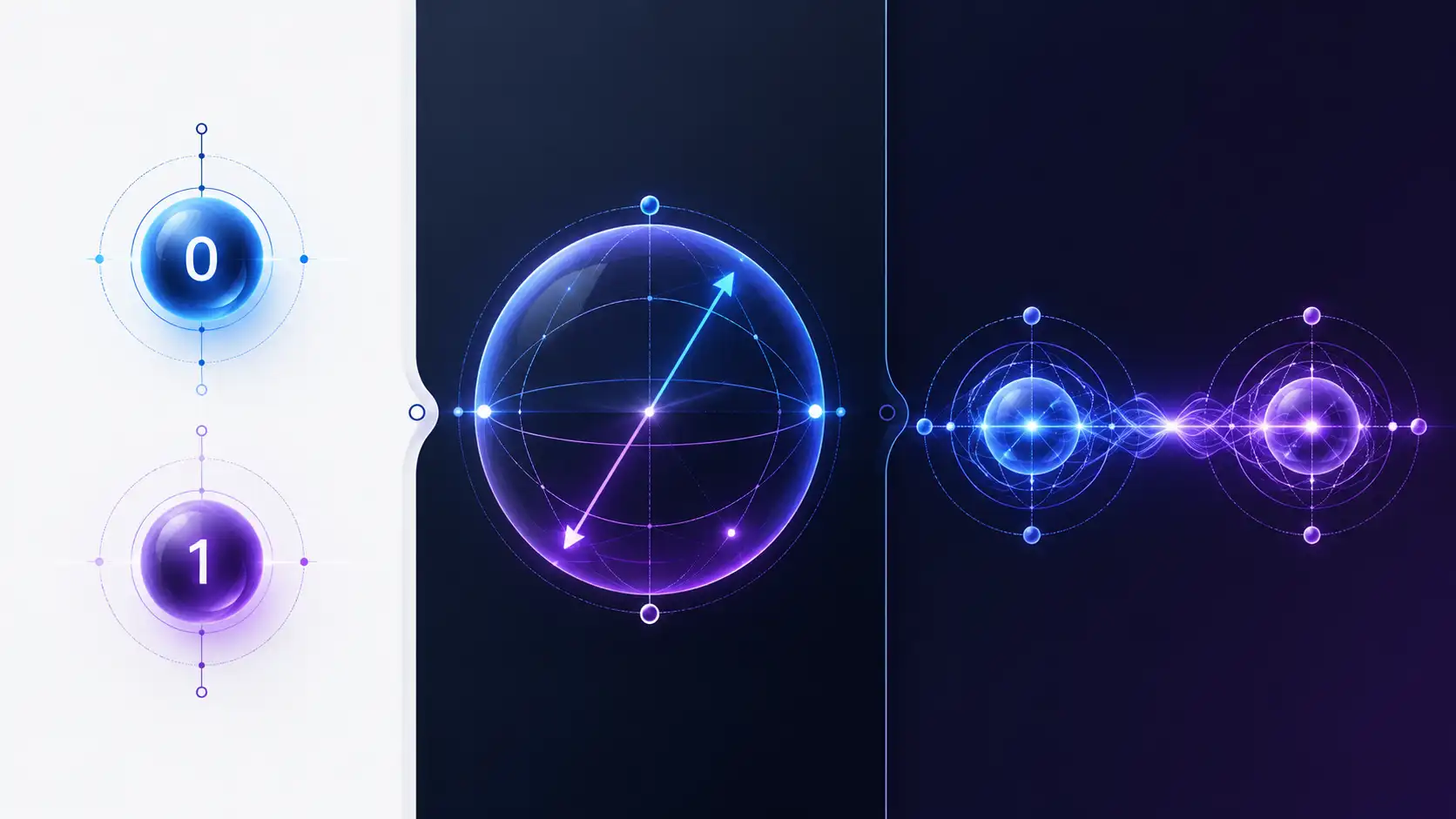
A qubit, or quantum bit, is the basic unit of information in quantum computing. Unlike a classical computer bit that can only be a 0 or a 1, a qubit can exist as a 0, a 1, or both simultaneously thanks to quantum physics, unlocking unprecedented processing power.
TL;DR
- Fundamental Unit: Qubits are the quantum equivalent of classical computer bits.
- Superposition: Qubits can hold multiple states at once, allowing massive parallel calculations.
- Entanglement: Qubits can link instantly across distances, enabling hyper-fast data sharing.
- Power Leap: Adding qubits increases computing power exponentially, not linearly.
- Fragility: Qubits are highly sensitive to their environment, requiring extreme cooling to stay stable.
- Not a Replacement: Quantum computers won’t replace your smartphone; they solve highly specific, complex mathematical problems.
Introduction
We are living through a computing revolution. For decades, Silicon Valley pushed the limits of traditional microchips, packing billions of tiny switches called transistors onto silicon wafers. But we are reaching the physical limits of materials. Enter quantum computing basics.
To understand why this technology is so revolutionary, you must understand its foundation: the qubit. Qubits are the building blocks of quantum information processing. Understanding how qubits work is essential to understanding the future of artificial intelligence, medicine, and cryptography.
Traditional computers process data sequentially, taking one step at a time. Quantum computers use the laws of quantum mechanics to process vast amounts of possibilities all at once, fundamentally altering how we interact with data.
What Is a Bit?
Before diving into the quantum world, let’s look at the device you are using to read this article. Whether it is a smartphone or a laptop, it relies on the binary system.
The fundamental unit of data in a traditional computer is the classical bit. A bit is a tiny electrical switch that can exist in one of two distinct states:
- 0 (Off / Low Voltage)
- 1 (On / High Voltage)
Every email you send, video you stream, and video game you play is broken down into billions of these 0s and 1s.
| Classical Bit Property | Description |
|---|---|
| Physical Reality | An electrical charge in a transistor |
| Logic Allowed | Deterministic (Strictly 0 OR 1) |
| Processing Style | Linear, one configuration at a time |
What Is a Qubit?
Definition: A qubit, short for quantum bit, is the basic unit of quantum information. It is the quantum mechanical counterpart to the classical silicon bit, capable of exploiting the bizarre properties of subatomic physics.
Where a classical bit is restricted to being a strict 0 or a strict 1, a qubit can exist in a state of superposition. This means it can represent a 0, a 1, or any fractional blend of both at the same exact time.
Why Qubits Matter
Because qubits can hold multiple states simultaneously, a group of them can hold an astronomically large number of possibilities at once. If you have two classical bits, they can form four possible combinations (00, 01, 10, or 11), but they can only look at one of those combinations at a single moment. Two qubits can hold all four combinations simultaneously.
Qubit vs Bit: The Core Differences
| Feature | Classical Bit | Quantum Qubit |
|---|---|---|
| Information Storage | Binary system (0 or 1) | Quantum system (0, 1, or both) |
| States | Static, absolute states | Fluid, probabilistic states |
| Processing Power | Grows linearly (N bits = N inputs) | Grows exponentially (N qubits = 2^N inputs) |
| Scalability | Easy to scale, works at room temp | Very difficult, requires extreme isolation |
| Applications | Browsing, daily apps, basic math | Molecular simulation, system optimization |
| Limitations | Cannot handle massive combinations | Extremely fragile, prone to calculation errors |
How Do Qubits Work?
Understanding how qubits work requires shifting from the rigid laws of daily life into the rules of probability.
Step 1: Setting the Quantum State
Engineers create qubits using microscopic particles, like an electron or a photon. They use lasers or microwaves to manipulate these particles into a specific quantum state.
Step 2: Embracing Probability
While working, a qubit lives in a cloud of probabilities. It does not choose to be a 0 or a 1 yet. Instead, it carries a changing mathematical probability of being either one.
Step 3: Measurement (The Collapse)
This is the strangest part of quantum physics. The moment a scientist observes or measures a qubit, its quantum magic vanishes. The qubit “collapses” out of its fluid state and hardens into a standard 0 or 1.
Step 4: Quantum Information Processing
To calculate an answer, a quantum computer manipulates these unmeasured, fluid states through a series of custom steps, filtering out wrong answers and amplifying the correct one before the final measurement is taken.
Understanding Superposition
The first major pillar of quantum mechanics is superposition.
What is Superposition Explained simply?
Superposition is the ability of a quantum system to be in multiple states at the same time until it is measured.
The Spinning Coin Analogy
Imagine placing a coin flat on a table. It shows either heads (1) or tails (0). This represents a classical bit.
Now, imagine spinning that coin on the table. Is it heads or tails while it spins?
It is effectively a blur of both states at once. The spinning coin is in a state of superposition. It only becomes a definitive “heads” or “tails” when you slam your hand down and stop it, which is exactly what happens when a quantum computer measures a qubit.
Why Superposition Is Powerful
- Parallel Computing: A standard computer tests keys for a lock one by one. A quantum computer in a state of superposition tries every single key at the exact same time.
- Data Density: It packs vast amounts of contextual data into a fraction of the hardware space.
Limitations of Superposition
Superposition is deeply delicate. The slightest temperature change, stray electromagnetic wave, or physical vibration will cause the spinning coin to fall flat early, destroying the calculation.
Understanding Entanglement
The second core pillar of quantum computing is entanglement.
What is Entanglement Explained simply?
Quantum entanglement is a phenomenon where two or more qubits become permanently linked. The state of one qubit instantly dictates the state of its entangled partner, no matter how far apart they are.
Einstein’s “Spooky Action at a Distance”
Albert Einstein famously doubted this concept, calling it “spooky action at a distance.” He disliked the idea that information could appear to travel faster than the speed of light. Yet, countless modern experiments have proven it is real.
The Magic Shoe Box Analogy
Imagine you have a pair of shoes. You place the left shoe in one box and the right shoe in an identical box. You keep one box and mail the other to a friend on the opposite side of the planet.
The moment you open your box and see the Left Shoe, you instantly know your friend holds the Right Shoe, even though they are thousands of miles away.
In the quantum world, it is even wilder: the shoes don’t choose to be left or right until one of the boxes is opened. Opening one instantly forces the other to choose its matching shape.
Benefits of Entanglement
Hyper-Connectivity: Entanglement connects qubits across a processor, allowing them to share data instantly without needing wires.
Exponential Acceleration: As you entangle more qubits, the processing capacity doubles with each addition (2^N).
Superposition vs Entanglement
While both properties make quantum information possible, they serve completely different purposes.
| Feature | Superposition | Entanglement |
|---|---|---|
| Core Definition | Existing in multiple states at once | A permanent link between particles |
| Main Purpose | Multiplies the data states per qubit | Shares data across qubits instantly |
| Physical Analogy | A spinning coin | A pair of separated matching shoes |
| Value to Computing | Allows parallel calculations | Explodes processing power exponentially |
How Qubits Enable Quantum Computing
When you combine superposition and entanglement, you create an entirely new framework for calculations. To learn more about the broader environment, check out our guide on What Is Quantum Computing?
Here is how a quantum processor uses qubits step-by-step to solve problems:
- Quantum Parallelism
Because qubits operate via superposition, a quantum computer can hold 2^N states simultaneously. For 300 perfectly entangled qubits, that is more configurations than there are atoms in the observable universe. - Quantum Gates
Instead of the standard silicon logic gates (AND, OR, NOT) used by your smartphone, quantum processors use quantum gates. These gates manipulate the probabilities of the qubits without measuring them, shifting the balance toward the desired answer. - Constructive Interference
Think of ocean waves crashing into each other. When they align perfectly, they create a larger wave (constructive interference). Quantum algorithms use this concept to cancel out wrong answers and amplify the correct one, making it highly visible at the end of the calculation.
Types of Physical Qubits
Scientists are testing different physical methods to build the most stable qubit. For a look at the machinery housing these systems, read How Does a Quantum Computer Work?
Here are the top physical qubit systems used by major technology firms today:
- Superconducting Qubits
How it works: Tiny loops of superconducting wire cooled to near absolute zero.
Who uses it: IBM, Google. - Trapped Ion Qubits
How it works: Individual atoms stripped of electrons (ions) suspended in place by electric fields.
Who uses it: Quantinuum, IonQ. - Photonic Qubits
How it works: Using individual particles of light (photons) routed through miniature optical chips.
Who uses it: PsiQuantum. - Silicon Quantum Dots
How it works: Trapping single electrons inside traditional silicon structures.
Who uses it: Intel. - Neutral Atom Qubits
How it works: Using arrays of lasers to hold uncharged atoms in place.
Who uses it: QuEra, Pasqal.
| Qubit Type | Main Advantage | Primary Weakness |
|---|---|---|
| Superconducting | Fast operation speeds | Requires massive, deep-freeze refrigeration |
| Trapped Ion | High stability and precision | Slower processing operational speeds |
| Photonic | Can run at room temperature | Hard to get photons to interact with each other |
| Quantum Dot | Leverages current silicon factories | Highly sensitive to manufacturing flaws |
| Neutral Atom | Easy to scale into large arrays | Complex laser control systems required |
Why Qubits Are Difficult to Build
If qubits are so powerful, why don’t we have quantum laptops yet? Building them presents immense engineering hurdles.
- Decoherence: The biggest enemy of quantum computing. If a qubit interacts with a single photon of warmth or vibration from the outside world, it loses its quantum state and falls out of superposition.
- Environmental Noise: Electromagnetic waves, temperature changes, and even the Earth’s magnetic field can introduce calculation errors.
- Extreme Temperature Demands: Most systems require operating temperatures around 0.015 Kelvin. That is colder than deep space, requiring complex dilution refrigerators.
- The Error Correction Burden: Because qubits are unstable, thousands of “physical qubits” are needed to double-check and run a single clean, reliable “logical qubit.”
Real-World Applications of Qubits
Quantum computers will not speed up daily web browsing or gaming. Instead, they excel at tackling complex mathematical problems that would take a traditional supercomputer thousands of years to solve.
- Artificial Intelligence: Speeds up pattern recognition in massive datasets, helping train next-generation AI models in fractions of the time.
- Drug Discovery: Simulates molecular interactions at an atomic level, shortening the time needed to develop life-saving medications.
- Financial Modeling: Minimizes market risk by analyzing millions of shifting global variables instantly.
- Cybersecurity: Quantum computers can crack current encryption standards, driving the development of new, hack-proof quantum cryptography.
- Logistics & Supply Chains: Optimizes global shipping routes, reducing fuel emissions and cutting supply chain delays.
How Many Qubits Are Needed?
he impact of a quantum computer depends heavily on the scale and quality of its qubits.
- 10–100 Qubits: The current baseline. Great for basic lab experiments, but easily simulated by powerful traditional computers.
- 1,000 Qubits: The tipping point for “Quantum Advantage,” where quantum systems begin outpacing traditional supercomputers at specific tasks.
- 100,000+ Qubits: The Holy Grail. A large-scale, fault-tolerant system that can change medicine, logistics, and material science globally.
The Future of Qubits
- As we look ahead, the focus is shifting away from simply building more qubits, and moving toward building better, more stable qubits.
- The industry is rapidly advancing toward building fault-tolerant quantum computers, which use advanced error correction to neutralize decoherence. Thanks to quantum cloud computing, everyday businesses don’t need to buy a multi-million-dollar refrigerator; they can simply lease processing time via the cloud to run highly specialized algorithms.
- For a deeper dive into this paradigm shift, explore our comprehensive breakdown: Quantum Computing vs Classical Computing
Key Takeaways
- A qubit is the fundamental unit of quantum information, replacing the classic binary 0 or 1 switch.
- Qubits leverage quantum physics to process complex, multi-layered data.
- Superposition allows a qubit to be a 0, a 1, or both simultaneously, like a spinning coin.
- Entanglement links qubits instantly across distances, enabling coordinated parallel computing power.
- Every qubit added to a system doubles its computational capacity exponentially.
- Qubits are exceptionally fragile and prone to decoherence from heat and vibration.
- Most quantum systems require specialized cooling setups that run colder than deep space.
- They will not replace classical PCs, but will instead act as specialized accelerators for complex math.
- Practical applications include molecular modeling, AI acceleration, and logistics optimization.
- The future relies on scaling up stable, error-corrected qubits via cloud access.
Frequently Asked Questions
A qubit (quantum bit) is the basic unit of information used by quantum computers, operating under the laws of quantum mechanics.
A qubit works by holding a fluid probability of being a 0, a 1, or both at the same time, until it is measured and collapses into a single value.
Superposition is the ability of a quantum particle to exist in multiple states simultaneously, much like a spinning coin is a blur of both heads and tails.
Entanglement is a quantum connection where two qubits become linked, meaning the state of one instantly reveals the state of the other, regardless of distance.
Qubits allow computers to process massive combinations of variables simultaneously, solving problems that are impossible for standard supercomputers.
A bit can only be a 0 or a 1 at any given moment. A qubit can be a 0, a 1, or any combination of both simultaneously.
Yes, thanks to superposition, qubits naturally hold multiple potential states at once until they are measured.
Qubits are highly sensitive to their environments. Heat, light, and vibrations cause them to lose their quantum properties, leading to calculation errors.
Modern systems range from dozens to over 1,000 physical qubits, though many of these are used for error correction.
They are placed inside specialized dilution refrigerators that use helium isotopes to lower temperatures down to nearly absolute zero.
Conclusion
The evolution of the qubit marks a major shift in human engineering. By moving past the rigid boundaries of standard binary computing and utilizing superposition and entanglement, qubits allow us to approach the world’s most complex problems from entirely new angles.
While building stable, error-free hardware remains a challenge, the potential rewards are immense. The qubit is reshaping the future of technology, paving the way for breakthroughs that will define the coming decades.
Great content! Keep up the good work!